
Plants
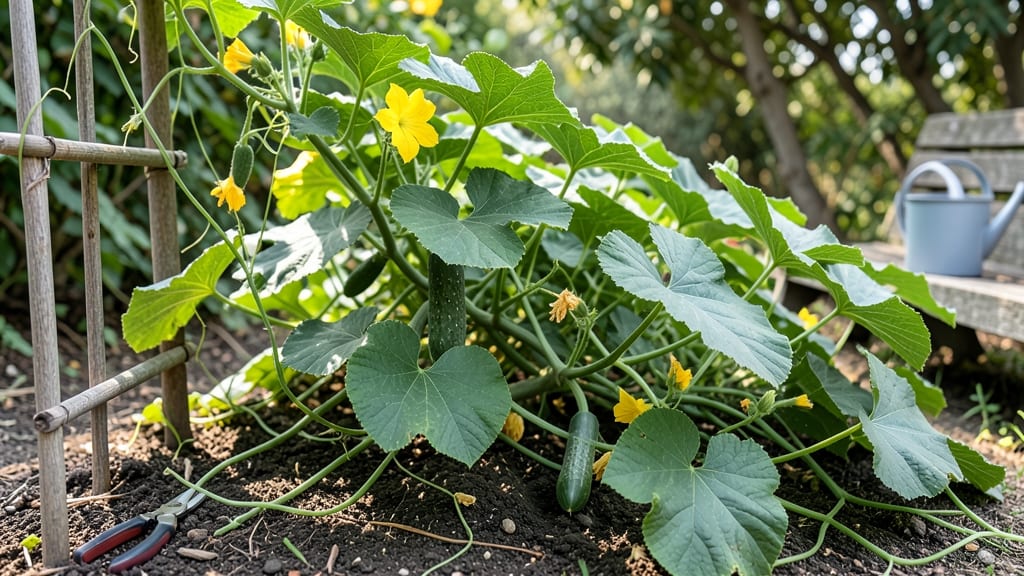
A cucumber vine looks like a fast-growing, sprawling green machine with heart-shaped leaves and tendrils that cling to anything in their path. 🌿 If you've ever seen a trellis covered in lush, vine-y growth with five-lobed leaves and delicate yellow flowers, that's your cucumber plant in action—though some varieties stay compact instead of climbing.
The real giveaway is the leaves: deep green, slightly fuzzy on the underside, and shaped like a hand with fingers spread wide. Stems are hollow and hairy, especially near the nodes where those telltale tendrils emerge. Flowers appear early, and if pollinated, tiny cucumbers form within weeks.
You'll recognize mature vines by their aggressive growth habit—some varieties spread 10+ feet in a season, while bush types stay contained. The difference between cucumber vines and squash or melon vines? Cucumbers have solitary tendrils (not paired) and their leaves are more finely lobed than squash's broader, rougher foliage.
Once you spot these features, you'll never confuse a cucumber vine with a weed again. The key is paying attention to those heart-shaped leaves and the way they climb—whether you're growing them vertically or letting them sprawl across the garden bed.
📚 In This Guide
- What you need
- Instructions
- Tips and common mistakes
- Wrapping up and next steps
What you need
- ● Magnifying glass (3x–10x magnification) – Helps examine leaf veins, texture, and tiny hairs.
- ● Notebook or sketchpad (8.5" x 11" or A4 size) – For jotting down details or sketching the vine’s features.
- ● Pencil or fine-liner pen – Essential for precise drawings of leaf shapes and vine patterns.
- ● Ruler (12-inch metric) – Measures leaf length, vine spacing, and stem diameter.
- ● Camera or smartphone – Capture high-resolution photos for reference (natural light is best!).
- ○ Gloves (optional but recommended) – Protects hands from prickly stems or sap (latex-free if sensitive).
- ● Hand lens with light – For inspecting trichomes (tiny hairs) or pest damage up close.
- ● Digital caliper – Measures stem thickness or leaf width with precision (±0.02 mm).
- ● Pruning shears – Safely trim vines for closer examination (sterilize with rubbing alcohol).
- ● Plant identification app (e.g., iNaturalist or PictureThis) – Cross-check your findings with AI-assisted plant databases.
- ● Grow light or greenhouse access – If you’re growing cucumbers, this helps study vine behavior in controlled conditions.
- ● Basic botany knowledge – Familiarity with terms like compound leaves, tendrils, and herbaceous stems helps.
- ● Access to a cucumber vine – Wild or cultivated (Cucumis sativus), preferably in its natural growing state (not wilting).
- ● Sunny weather (if outdoors) – Bright light enhances visibility of leaf patterns and vine color.
- ● Patience – Cucumber vines grow fast! Observe over a few days to note changes in leaf shape or vine direction.
Identifying a cucumber vine: key visual traits to spot in your garden
Here's how to recognize a healthy cucumber vine at every growth stage—no gardening degree needed.
🌱 Step 1: Observe the Leaf Shape and Arrangement
Cucumber leaves are the first clue—look for large, 5-7 lobed leaves with jagged edges that resemble a maple leaf. They grow in a spiral pattern around the stem, with each new leaf emerging slightly higher than the last. Young leaves start small and fuzzy, but mature leaves can reach 6-12 inches wide.
Run your fingers along the stem—you'll feel the leaves alternate sides rather than growing in pairs like some vines. The undersides often have a pale green or slightly hairy texture, which helps distinguish them from squash or melon leaves. If you see heart-shaped leaves, you're looking at a different plant entirely.
🌿 Step 2: Check the Vine's Growth Pattern and Tendrils
Cucumber vines grow in two distinct ways: trailing or climbing. Trailing types sprawl along the ground, while climbing vines produce spiral tendrils that wrap around supports. These tendrils are your key identifier—they're thin, curly, and appear at leaf nodes, curling around trellises or fences.
Watch how the vine grows: healthy cucumber vines put out 12-18 inches of new growth daily in warm weather. The main stem is hollow and ribbed, with side shoots emerging at leaf nodes. If you see square stems, that's a dead giveaway for a different plant—cucumbers always have rounded, ribbed stems.
💧 Step 3: Examine the Flowers and Fruit Nodes
Male flowers appear first as small, yellow blossoms with no swelling at the base. They hang from long stems and don't produce fruit. Female flowers have a tiny cucumber-shaped swelling at their base—this is where fruit develops. Both types grow in the leaf axils, where the leaf meets the stem.
Look for tiny bumps along the main vine where flowers will emerge. These appear as small, rounded swellings about 1/4 inch wide before blooming. Healthy vines produce flowers continuously, with new buds forming every 3-5 inches of growth. If you see white or purple flowers, you're looking at a different cucurbit family member.
✂️ Step 4: Identify the Fruit Development Stages
Cucumber fruits start as small, green bumps about 1 inch long that grow directly from female flowers. They're smooth and slightly fuzzy at first, then develop ridges as they mature. The vine supports fruit growth by producing additional tendrils near each developing cucumber to bear the weight.
Watch for yellowing leaves near fruit clusters—this is normal as the plant diverts energy to fruit production. Healthy vines produce fruit along the entire length, with new cucumbers emerging every 6-12 inches of vine. If you see fruit growing directly from the main stem without leaf nodes, it's likely a different squash variety.
🌞 Step 5: Compare to Common Lookalikes
Cucumber vines often get confused with squash, melons, or bitter melon. Squash vines have broader leaves with more pronounced lobes and produce large, blocky fruit. Melon vines have hairier stems and larger, more rounded leaves. Bitter melon leaves are more pointed with a distinct bitter aroma when crushed.
Run this quick check: crush a leaf between your fingers. Cucumber leaves have a mild, fresh scent with no bitterness. Squash leaves smell slightly earthy, while melon leaves have a sweet, musky aroma. The vine's growth speed is another clue—cucumbers grow aggressively in warm weather, while melons grow more slowly.
Tips & tricks for identifying cucumber vines like a pro
Real talk: I've spent hours in the garden staring at vines wondering if they're cucumbers or something else. Here's what nobody tells you—these tricks will help you spot them instantly.
Leaf Texture is Your Secret Weapon: Pay attention to that fuzzy underside of the leaves mentioned in Step 1. Run your thumb along the leaf veins—cucumber leaves have a slightly hairy texture that's less pronounced than melon leaves but more noticeable than squash. This fuzzy quality helps distinguish them from lookalikes, especially when crushed. I've found that morning light makes this texture more visible, so check your plants early in the day.
Growth Speed is Non-Negotiable: The 12-18 inches of daily growth mentioned in Step 2 is your best friend. If you're seeing new growth that fast during warm weather (75°F+), you're likely dealing with cucumbers. I've seen some gardeners miss this because they check too infrequently. Set a reminder to examine your vines every 2-3 days during peak growing season—you'll notice the aggressive growth pattern that sets cucumbers apart from slower-growing melons.
Tendril Location is the Ultimate Test: Those spiral tendrils at leaf nodes from Step 2 are your golden ticket. Here's what I do: pick a leaf and look directly below where it meets the stem. If you see a tiny curly tendril forming there, that's your confirmation. I've used this trick to distinguish cucumbers from squash vines that often have similar leaf shapes but lack these distinctive tendrils.
Scent Test is a Game-Changer: The smell test from Step 5 is often overlooked but incredibly reliable. Crush a leaf between your fingers and take a deep sniff. Cucumber leaves should smell fresh and mild—almost like a mild cucumber scent. If you detect any bitterness or earthy aroma, you're looking at something else. I keep a small notebook in my garden to track which plants have which scents, and this has saved me from misidentifying plants countless times.
Pro Tips for What Does A Cucumber Vine Look Like
- Real talk: I've spent hours in the garden staring at vines wondering if they're cucumbers or something else.
- Leaf Texture is Your Secret Weapon: Pay attention to that fuzzy underside of the leaves mentioned in Step 1.
- Growth Speed is Non-Negotiable: The 12-18 inches of daily growth mentioned in Step 2 is your best friend.
Frequently asked questions
Got questions about cucumber vines?
Here are some of the most common ones—plus quick, actionable answers to help you grow (or recognize!) these fast-spreading plants with ease.
How do I tell a cucumber vine apart from a weed or other vines?
A healthy cucumber vine has large, jagged, heart-shaped leaves (3–6 inches wide) with rough, hairy stems that twine clockwise around supports. Weeds like morning glory or bindweed have smoother leaves or different growth patterns. Pro tip: Check for tiny yellow flowers (male or female) or baby cucumbers—they’re dead giveaways!
When do cucumber vines start looking like vines (vs. seedlings)?
Seedlings sprout round, lobed leaves first, but by 2–3 weeks, vines develop the classic twining habit and larger, serrated leaves. If you’re growing from seed, expect visible vines by the time the first true leaves appear (about 10–14 days after germination). Wait until vines are 3–4 feet long to prune or train them.
Why is my cucumber vine’s leaves turning yellow or curling?
Yellowing leaves often signal overwatering, underwatering, or pests (like cucumber beetles). Curling? Likely heat stress or spider mites. Check soil moisture (it should stay consistently damp but not soggy) and inspect the undersides of leaves for tiny webs or bugs. Fix it fast: Adjust watering, use row covers, or spray with neem oil.
Can I grow cucumbers without a vine (e.g., bush varieties)?
Yes! Bush cucumbers (like ‘Bush Champion’ or ‘Spacemaster’) grow compact, non-twining vines (1–2 feet tall) and produce fruit without trellises. They’re perfect for containers or small spaces. Trade-off: Yields are smaller than vining types, but they’re low-maintenance and great for beginners!
Do cucumber vines die back in winter, and how do I prepare for next year?
Cucumber vines are annuals and die after harvest, but you can save seeds or prep soil for next season. Before frost: Pull up vines, compost healthy debris (no diseased plants!), and add compost or aged manure to replenish nutrients. Pro tip: Plant winter cover crops (like clover) to protect soil health.
| Quick Fixes for Common Vine Issues |
|---|
|
Vines not twining? Train them gently with twine or a trellis. Leaves wilting? Water deeply at the base (avoid overhead spray). Few flowers/fruit? Hand-pollinate with a paintbrush or add compost. |
Wrapping up and next steps
Now that you’ve mastered the art of spotting a cucumber vine—from its heart-shaped leaves and tendril-climbing habits to its fast-growing nature—you’re ready to embrace the fun of gardening! 🌱 Whether you’re a beginner or a seasoned green thumb, recognizing these key traits will help you cultivate healthy plants and bountiful harvests.
Ready to take the next step? Try planting your own cucumbers this season—start with a few vines, and watch your garden transform! 🌿