
Plants
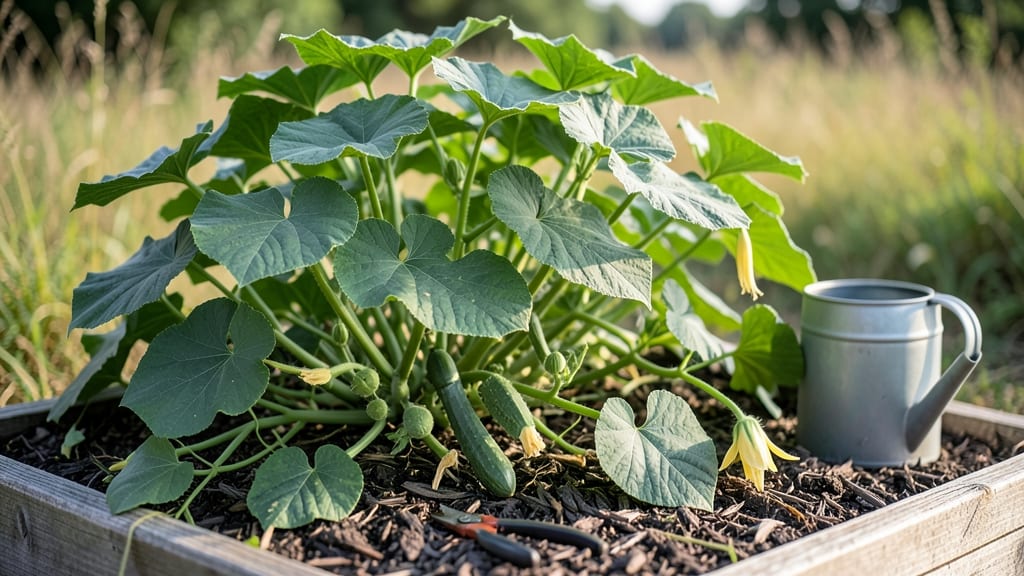
Cucumber buds look like small, delicate green flowers with five thin, slightly pointed petals arranged in a star shape around a central yellow or white core. They grow in clusters at leaf junctions and resemble miniature daisies before blooming fully.
These tiny green blossoms are the early stage of what will become your cucumbers, and their appearance changes as they mature. 🌱 At first, they start as small bumps at the leaf joints, then develop into those distinctive five-petaled shapes you might mistake for tiny daisies.
The key identifier is their delicate structure—the petals are paper-thin and slightly pointed, with a bright yellow or white center that makes them stand out against the plant's darker green leaves.
What many gardeners don't realize is that these buds develop differently depending on whether they'll produce fruit. Female buds, which will eventually bear cucumbers, have a tiny swelling at their base, while male buds remain more uniform in shape.
This distinction becomes crucial when you're trying to encourage better yields in your garden.
💡 In This Article
- Identifying Cucumber Flower Buds by Growth Stages
- How to Tell Cucumber Buds Apart from Pests or Diseases
Identifying cucumber flower buds by growth stages
Cucumber buds begin their life as tiny, barely noticeable green bumps—about 1/8-inch wide—forming at the leaf axils (the junction where leaves meet the stem).
These initial growths are so small they often blend into the plant's foliage, but they're identifiable by their slightly raised, dome-like shape that distinguishes them from the flat leaf surfaces.
As they mature over 3-5 days, these buds swell and develop the signature five-petaled structure, with petals that unfurl into a star shape reminiscent of a miniature daisy.
The petals themselves are what make these buds instantly recognizable—they're thin, translucent, and slightly waxy to the touch, with edges that curve gently backward.
Their color starts as a pale green but deepens to a vibrant lime green as they approach full bloom, while the central core remains a bright yellow or white, creating a striking contrast. 🌿 The stem attachment is another key identifier: buds grow directly from the main stem or leaf axils on short, hairy stems, unlike leaves which attach more broadly to the plant.
Here's where it gets interesting: the buds' development reveals their gender. Female buds (the ones that will produce fruit) have a small, rounded swelling at their base where the cucumber will eventually form. Male buds, which won't bear fruit, remain more uniform in shape with no visible swelling.
This gender distinction becomes visible about 2-3 days before flowering, giving gardeners a head start on identifying which buds to protect for better yields.
Temperature plays a crucial role in their development. Buds form most vigorously when daytime temperatures stay between 70-85°F and nights remain above 55°F. Below 50°F, buds may fail to open properly, while above 90°F, they can become heat-stressed and drop prematurely.
This is why morning inspections are ideal—the cooler temperatures help buds maintain their delicate structure, making them easier to identify accurately.
What most gardeners overlook is how the buds' orientation changes as they mature. Early-stage buds grow upright, but as they near full bloom, they begin to angle downward slightly, almost as if bowing under their own weight.
This downward shift is particularly noticeable in female buds due to the developing fruit swelling at their base. 🌱 Understanding this progression helps distinguish healthy buds from potential problems like stunted growth or disease.
For a quick visual comparison, think of these buds as nature's version of a five-pointed star: each petal measures roughly 1/4-inch long when fully developed, with veins running parallel to the edges that give them a delicate, almost lace-like appearance.
The central core contains both male and female reproductive parts, which become visible as the bud opens completely into a flower.