
Vegetables
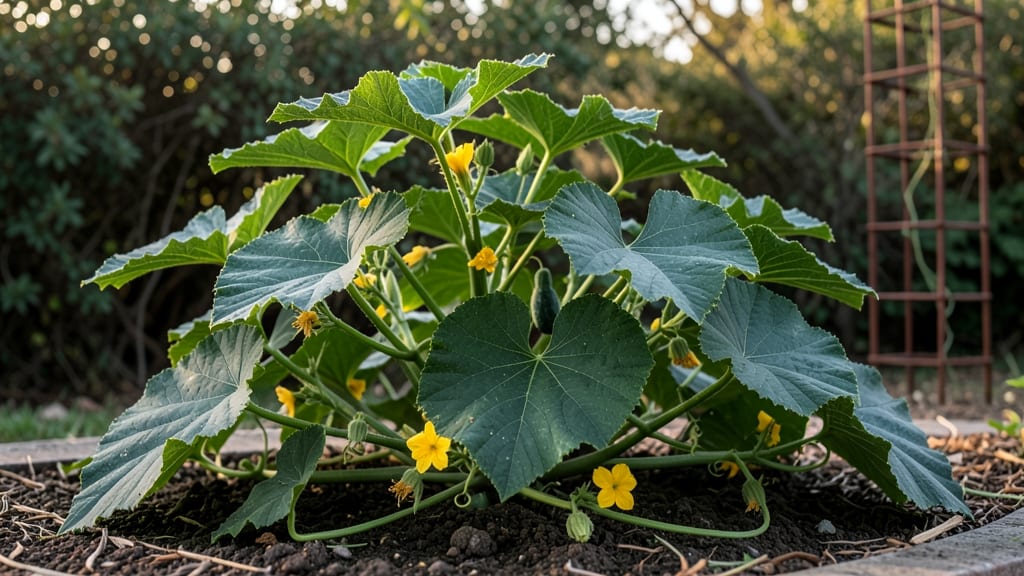
Cucumber leaves look like broad, heart-shaped foliage with dark green coloring, jagged serrated edges, and prominent veins radiating from the central stem. These leaves grow alternately along vines, typically spanning 4-6 inches wide with a slightly waxy surface.
Cucumber leaves are instantly recognizable by their distinctive shape and vibrant appearance. 🌿 The broad, heart-shaped blades create a striking contrast against the plant's sprawling vines, while the jagged edges and prominent veins give them a rugged yet elegant look.
These leaves grow alternately along the stems, unlike some squash varieties that display opposite leaf patterns. The waxy texture not only helps repel water but also contributes to their glossy appearance when healthy.
What makes these leaves particularly useful for identification is their size and growth pattern. 🌱 Unlike smaller herb leaves, cucumber foliage typically spans 4-6 inches wide, providing ample surface area for photosynthesis.
The alternating arrangement along the vine creates a distinctive visual pattern that gardeners can use to differentiate cucumbers from other vine crops like melons or pumpkins.
💡 In This Article
- Identifying Cucumber Leaves: Key Botanical Features
- How to Spot Healthy vs Diseased Cucumber Leaves
Identifying cucumber leaves: key botanical features
Cucumber leaves belong to the Cucurbitaceae family and exhibit a unique botanical structure that sets them apart from other vine plants. The heart-shaped form, known scientifically as cordate, creates a distinctive silhouette with a pointed tip called the apex.
These leaves typically measure between 4-6 inches wide and 6-12 inches long, with the larger leaves appearing on mature plants. The jagged edges, called serrations, create a saw-toothed pattern that's more pronounced than similar-looking squash leaves, which tend to have smoother margins.
The vein structure is particularly diagnostic - cucumber leaves feature palmate venation, where 5-7 main veins radiate outward from the central stem like fingers on a hand. This creates a web-like pattern that's more intricate than the simpler pinnate venation found in plants like zucchini.
The dark green color comes from high chlorophyll content, which helps the plant efficiently capture sunlight for photosynthesis. 🌿 Interestingly, the waxy coating isn't just for show - it's a natural adaptation that reduces water loss and helps repel fungal spores, making cucumber plants more resilient in humid growing conditions.
One of the most reliable identification features is the alternate leaf arrangement - each leaf grows from a single node on the vine, alternating sides as you move up the stem.
This creates a spiral pattern when viewed from above, unlike squash plants which often display opposite leaf arrangements where pairs of leaves emerge from the same node. The stems themselves are typically hairy and angled, with tendrils that help the plant climb.
These botanical details work together to create a visual fingerprint that makes cucumber leaves instantly recognizable to experienced gardeners.
When comparing cucumber leaves to their closest lookalikes, the differences become clear upon closer inspection. Squash leaves, for example, tend to be more lobed with deeper indentations, while melon leaves often have a rougher texture and more pronounced hairiness.
The serrations on cucumber leaves are more uniform and less pronounced than the jagged edges found on bitter melon foliage.
Even the aroma differs - crushed cucumber leaves release a faint, fresh scent that's absent in other cucurbit plants. 💛 These subtle but distinctive features make cucumber leaves one of the most visually identifiable among garden vegetables.
Understanding these botanical features isn't just for plant enthusiasts - it's practical knowledge for gardeners. The leaf shape and arrangement influence how the plant grows, with the large surface area maximizing photosynthesis while the waxy coating helps prevent disease.
The serrated edges even play a role in water runoff, preventing water from pooling on the leaves where fungal diseases could develop. These features work together to create a plant that's both visually striking and highly efficient at producing fruit.
For those new to gardening, here's a quick visual checklist to confirm you're looking at cucumber leaves:
- Shape: Heart-shaped with pointed tip (cordate)
- Edges: Jagged serrations (not smooth or deeply lobed)
- Vein pattern: 5-7 main veins radiating from center
- Arrangement: Leaves alternate along vine (not opposite)
- Texture: Slightly waxy surface
- Stem: Hairy with angled growth and tendrils
Armed with these details, you'll never confuse cucumber leaves with their lookalikes again - and you'll gain a deeper appreciation for how these botanical features contribute to the plant's success in the garden. 🌱