
Companion Plants
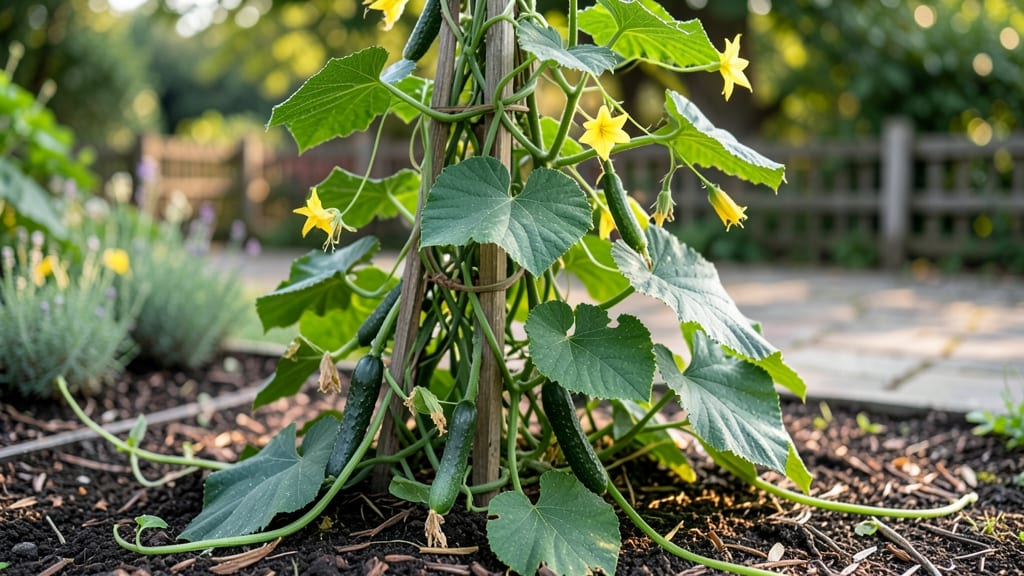
To take care of cucumber plants, maintain consistent moisture, plant in well-draining soil with full sun exposure, and prune regularly to promote healthy growth and prevent disease. Support vining varieties with trellises and use compost or balanced fertilizer every 3-4 weeks.
Cucumbers thrive when given the right balance of sunlight, water, and nutrients. 🌱 They need at least 6-8 hours of direct sunlight daily to produce high-quality fruit, and their roots prefer soil that drains well to avoid rot.
I’ve found that mulching around the base helps retain moisture while keeping roots cool. For best results, aim to water deeply once or twice weekly, adjusting based on your climate—too much water can lead to blossom-end rot, while too little stresses the plant.
Regular pruning isn’t just about shape; it also improves airflow, reducing the risk of fungal diseases like powdery mildew, which can devastate yields.
💡 In This Article
- Optimal Growing Conditions for Cucumber Plants
- Step-by-Step Cucumber Plant Maintenance Guide
Optimal growing conditions for cucumber plants
Cucumbers are warm-season plants that thrive when temperatures consistently stay between 70-90°F during the day and above 60°F at night. Below 55°F, growth slows dramatically, and flowers may drop without setting fruit.
This temperature sensitivity explains why cucumbers struggle in cooler climates unless started indoors or planted after the last frost. The ideal growing season spans roughly 70-90 days, depending on variety—early varieties like 'Straight Eight' mature in 50-55 days, while larger types like 'Lemon Cucumber' take 65-75 days.
Sunlight is non-negotiable for cucumbers, which require 6-8 hours of direct sunlight daily to develop flavorful fruit. Without adequate light, plants become leggy and produce bitter, seedy cucumbers. The chlorophyll production peaks at 70% relative humidity, but too much moisture in the air promotes fungal diseases like powdery mildew.
This is why proper spacing (typically 2-3 feet apart for bush types, 3-4 feet for vining) is critical—it ensures airflow while maximizing sunlight exposure. 🌞 The soil's pH should range from 6.0-6.8, as cucumbers absorb nutrients most efficiently in this slightly acidic range.
Moisture management is where many gardeners go wrong. Cucumbers have shallow roots that need consistent hydration, but soggy soil leads to root rot. The key is maintaining 1-2 inches of moisture in the topsoil at all times—this translates to watering deeply 1-2 times per week (more in extreme heat).
Drip irrigation or soaker hoses work best, as they deliver water directly to the roots without wetting the leaves, which reduces disease risk. I’ve noticed that morning watering minimizes evaporation and gives plants a full day to dry out, preventing nighttime fungal growth.
Well-draining soil is another critical factor. Cucumbers hate "wet feet"—their roots need oxygen to function properly. Amending clay soil with 2-3 inches of compost or using raised beds improves drainage while adding organic matter that retains moisture without compacting.
The ideal soil mix should have 10-20% organic content, which improves water retention and nutrient availability. For container growing, use a lightweight potting mix with perlite or vermiculite to prevent compaction.
One often-overlooked detail is the role of calcium in preventing blossom-end rot, a common cucumber problem. Soil with insufficient calcium (below 0.1% by weight) causes the fruit's blossom end to turn brown and mushy. Adding crushed eggshells or a balanced fertilizer with 5-10% calcium can prevent this issue.
The connection between soil health and fruit quality highlights why testing your soil before planting pays off—it lets you address deficiencies proactively.
Finally, consider the impact of wind. While cucumbers need airflow, strong winds can damage delicate vines and flowers. Planting near a windbreak (like a fence or taller crops) creates a microclimate that protects plants while still allowing sunlight penetration.
This small adjustment can mean the difference between a thriving vine and one struggling to set fruit. 💫