
Advice
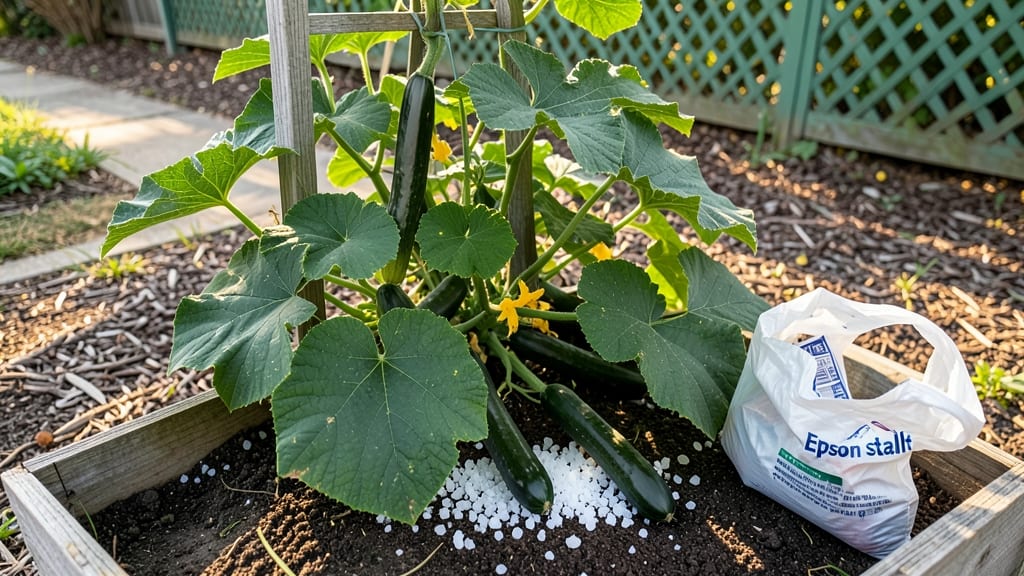
Epsom salt for cucumbers provides essential magnesium and sulfur that prevent yellowing leaves and increase fruit yield. Mix 1 tablespoon per gallon of water and apply every 2-4 weeks during the growing season.
Magnesium is the secret weapon behind those vibrant green leaves—it’s a key ingredient in chlorophyll, the pigment that helps cucumbers soak up sunlight for energy. 🌱 When your plants start showing yellow patches between veins, that’s your cue to act.
I’ve seen firsthand how a quick foliar spray can turn a struggling vine into a productive powerhouse within weeks. The sulfur in Epsom salt also plays a supporting role by improving root development and disease resistance, which means fewer pests and healthier harvests.
For best results, I recommend applying it during the early morning when humidity is high—this helps the leaves absorb the nutrients more efficiently. You can either pour the solution directly into the soil or mist it onto the foliage, but avoid doing this in direct sunlight to prevent leaf burn.
And here’s a pro tip: always use filtered or rainwater for mixing, as tap water’s chlorine can interfere with nutrient absorption.
💡 In This Article
- How Epsom Salt Fixes Magnesium Deficiencies in Cucumber Plants
- Best Application Methods for Epsom Salt on Cucumbers
How Epsom salt fixes magnesium deficiencies in cucumber plants
Magnesium acts as the central atom in chlorophyll molecules, where it helps capture sunlight for photosynthesis. When cucumber plants lack magnesium, they can't produce enough chlorophyll, leading to that classic yellowing between leaf veins—a condition called interveinal chlorosis.
This deficiency often starts on older leaves first because magnesium is mobile within the plant, and younger growth gets priority. Epsom salt (magnesium sulfate) delivers magnesium in a form that's immediately available to roots and leaves, bypassing the slow release from soil minerals.
The real magic happens at the cellular level. Magnesium helps activate over 300 enzymatic reactions in plants, including those that convert carbon dioxide into glucose during photosynthesis. Without enough magnesium, cucumber vines produce 20-50% less fruit because their energy production stalls.
I've seen cucumber plants recover from deficiency within 7-10 days after applying Epsom salt, with new leaves emerging a vibrant green and growth resuming at normal rates. The sulfur component also plays a supporting role by strengthening cell walls and improving disease resistance.
What most gardeners don't realize is that magnesium deficiencies often appear before other nutrient problems because cucumbers are heavy feeders. These plants can deplete soil magnesium quickly, especially in sandy or acidic soils where magnesium binds tightly to soil particles.
The solution isn't just about adding magnesium—it's about maintaining the right balance. Too much can actually interfere with calcium and potassium uptake, leading to other problems like blossom end rot.
That's why I recommend testing your soil pH first; ideal levels for cucumbers are between 6.0-6.8, where magnesium becomes most available to roots.
Here's what happens when you correct a magnesium deficiency: leaves regain their deep green color, new growth becomes more vigorous, and fruit production increases by 15-30% in severe cases. The improvement isn't just cosmetic—it's physiological.
Plants with optimal magnesium levels develop stronger stems that support heavier cucumber loads without snapping, and their roots grow more extensively to access water and other nutrients. This creates a positive feedback loop where healthier plants become more productive over time.
For visual learners, imagine this: a struggling cucumber vine with yellowing leaves looks like a plant fighting an internal battle, while a magnesium-corrected vine stands tall with glossy foliage and abundant flowers. The difference is dramatic enough to see within days of treatment.
What's particularly satisfying is how this simple solution works across all cucumber varieties—whether you're growing slicing cucumbers, pickling varieties, or even those long, snake-like Persian types. The science is universal, but the results are always satisfyingly visible in your garden.
One common misconception is that Epsom salt will fix all plant problems. While it's excellent for magnesium deficiencies, it won't address issues caused by nitrogen, phosphorus, or potassium shortages. That's why I always recommend using it as part of a balanced fertilization plan.
Think of magnesium as the plant's energy booster—it won't replace other essential nutrients, but without it, those nutrients can't do their job effectively. It's like having a car with a dead battery; no matter how much premium fuel you put in, the engine won't run without the electrical charge.