
Pests and Diseases
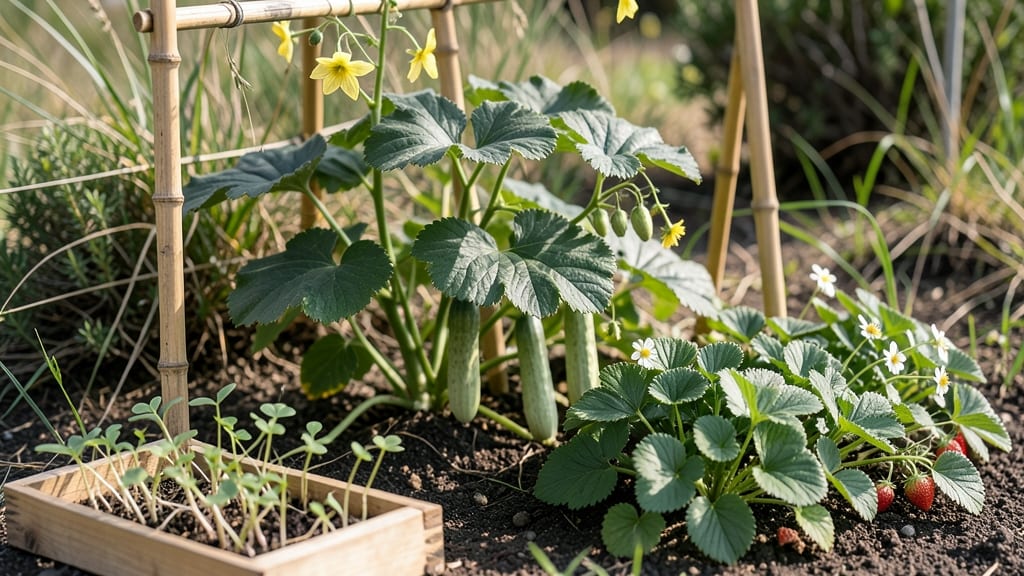
You can plant cucumbers and strawberries together, but it's risky due to their conflicting needs: cucumbers require deep soil and consistent moisture, while strawberries thrive in well-draining soil with minimal competition. Their opposing growth patterns often result in reduced harvests for one or both plants.
While it might seem practical to combine these two crops in a small garden, their fundamental differences create real challenges.
Cucumbers spread aggressively with sprawling vines that can smother strawberry plants, while strawberries prefer drier conditions that cucumbers' thirsty roots disrupt. 🌱 The nutrient competition is particularly harsh—cucumbers are heavy feeders that deplete soil nitrogen quickly, leaving strawberries starved for essential growth elements.
Even if you manage the spacing, disease risks increase when these plants share the same growing space, as cucumbers' broad leaves create humid microclimates that strawberries dislike.
For successful growing, consider dedicating separate garden beds or containers to each crop. If space is extremely limited, plant them at opposite ends of a raised bed with clear physical barriers between them. This approach allows you to enjoy both harvests without compromising either plant's health or productivity.
💡 In This Article
- Why Cucumbers and Strawberries Clash in the Garden
- Smart Companion Planting Alternatives for Cucumbers and Strawberries
Why cucumbers and strawberries clash in the garden
The core conflict between cucumbers and strawberries stems from their fundamentally different growth habits and resource demands. Cucumbers are vigorous vining plants that spread aggressively, requiring at least 3-5 feet of horizontal space and deep soil penetration (up to 12-18 inches) for their extensive root systems.
Strawberries, however, grow low to the ground with shallow roots (6-12 inches) and prefer a more contained, compact growth pattern.
When planted together, cucumber vines can smother strawberry plants, blocking sunlight and air circulation—a critical issue since strawberries need 6-8 hours of direct sunlight daily for optimal fruit production.
The moisture requirements create another major battleground. Cucumbers demand consistent soil moisture, often requiring daily watering during hot weather to maintain their tender, juicy fruits. Strawberries, however, prefer well-draining soil that dries out slightly between waterings to prevent rot.
When cucumbers' thirsty roots dominate the space, they create a soggy environment that strawberries detest, leading to fruit rot and mold growth on berries. This moisture mismatch is particularly problematic in containers, where drainage becomes even more critical for strawberries while cucumbers continue to demand frequent watering.
Nutrient competition adds another layer of complexity. Cucumbers are heavy feeders, rapidly depleting soil nitrogen as they grow their extensive foliage and fruit. A single cucumber plant can consume up to 2 pounds of nitrogen per season, leaving strawberries nutrient-starved.
Strawberries, while not as demanding, still require balanced nutrition—particularly potassium and phosphorus—for sweet, vibrant fruit. When grown together, cucumbers often outcompete strawberries for these essential elements, resulting in smaller berries and reduced yields for both crops. This nutrient imbalance is especially noticeable in small garden beds where root systems intertwine.
Disease transmission presents a final major risk when these plants share space. Cucumbers' broad leaves create a humid microclimate that traps moisture, ideal conditions for fungal diseases like powdery mildew and downy mildew. Strawberries are susceptible to these same pathogens but lack the robust foliage to withstand prolonged dampness.
The close proximity increases the chance of cross-contamination, where spores from cucumber diseases land on strawberry leaves, potentially ruining an entire harvest. This risk is compounded when both plants share the same irrigation system, spreading pathogens through water droplets.
Even their growth cycles conflict. Cucumbers grow rapidly from planting to harvest in just 50-70 days, while strawberries produce fruit over 2-4 weeks in spring (June-bearing varieties) or continuously (everbearing types). This timing mismatch means cucumbers will dominate the garden space during strawberries' peak fruiting period, creating direct competition.
The physical space occupied by cucumber vines leaves little room for strawberry runners to spread and establish new plants, further reducing the berry harvest. This spatial conflict is particularly acute in small urban gardens where every inch of space is precious.
What most gardeners don't realize is how these conflicts create a feedback loop of declining health. Stressed strawberries become more susceptible to pests like slugs and birds, while cucumbers underperforming due to poor drainage may develop bitter fruits or fail to set properly.
The combined stress often leads to reduced yields for both crops, making the initial space-saving effort counterproductive. This is why experienced gardeners recommend keeping these plants separate unless using very specific containment strategies.