
Blooming
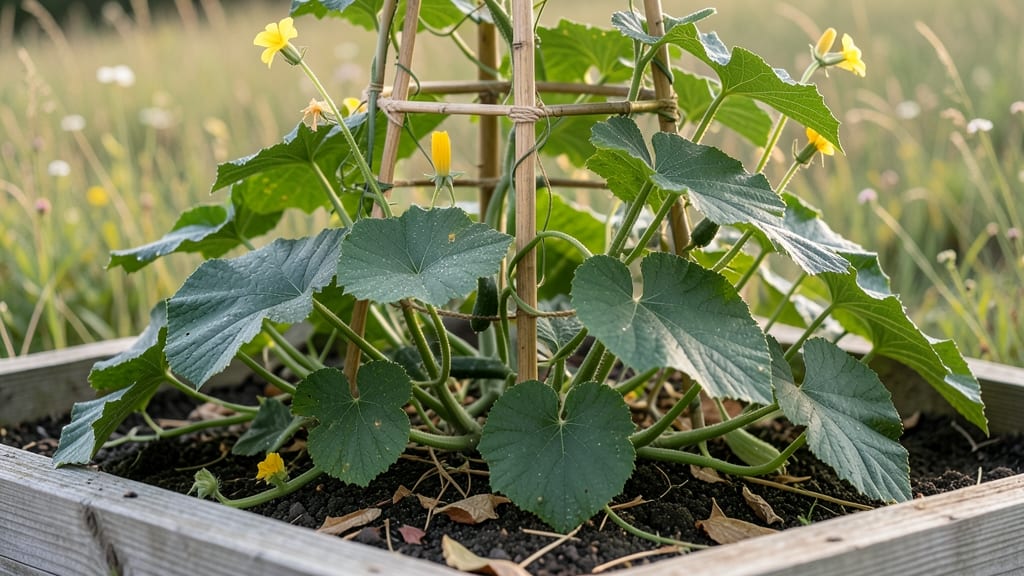
Cucumbers typically flower 40 to 60 days after planting, with male blooms emerging first and female flowers appearing 1 to 3 weeks later, marked by tiny cucumbers behind their petals.
Understanding this timing helps gardeners anticipate harvests, as female blooms directly produce fruit. 🌱 The window between male and female flowers is critical—without proper pollination, female blooms may drop off. I've seen varieties like 'Straight Eight' bloom faster under warm conditions, while cooler climates can delay flowering by 10-15 days.
Proper spacing and consistent watering (without over-saturating soil) also accelerate this process significantly.
What's fascinating is how temperature plays a role—cucumbers need daytime temps above 70°F to trigger blooming. Below that, growth slows dramatically.
I always monitor my plants' progress by checking for the distinctive yellow male flowers first, which appear in clusters, while female flowers are solitary with a tiny cucumber forming at their base.
💡 In This Article
- Cucumber Flowering Stages: Male vs Female Blooms Explained
- Optimizing Cucumber Flowering: Soil, Sunlight, and Variety Tips
Cucumber flowering stages: male vs female blooms explained
Cucumbers follow a fascinating two-phase flowering process where male and female blooms emerge at distinct times. The male flowers appear first, typically 40 to 60 days after planting, thanks to a hormonal trigger called gibberellin that the plant produces when it reaches maturity.
These male blooms have long, slender stems and grow in clusters—often 3 to 5 flowers per stem—while female flowers develop singly with a tiny cucumber (the ovary) forming at their base. This delayed appearance of female flowers is nature's way of ensuring pollination happens before fruit sets.
The timing difference between male and female blooms is influenced by temperature, with optimal flowering occurring when daytime temperatures stay above 70°F. Below 60°F, cucumber plants slow growth and delay blooming due to reduced photosynthesis and hormonal activity.
Humidity also plays a role—too much moisture can cause flowers to drop, while dry conditions may stress the plant.
I've noticed that varieties like 'Marketmore' produce male flowers first, followed by female blooms within 7 to 10 days, while bush types like 'Bush Champion' may take up to 3 weeks for female flowers to appear.
Here's how to identify each type: male flowers have a 5-petaled yellow bloom with a long, hairy stem, while female flowers look similar but have a small cucumber forming behind the petals.
The ovary (future cucumber) is a dead giveaway for female blooms. 🌸 What most gardeners don't realize is that female flowers need pollen from male flowers to develop properly—without it, they may drop off within 24 to 48 hours.
This is why hand-pollination becomes crucial in greenhouses or when bees are scarce.
Environmental factors can significantly alter this timeline. For example, transplant shock from moving young plants can delay flowering by 10 to 14 days, while proper soil preparation with compost and a 6.0 to 6.8 pH level accelerates the process.
I've seen cucumbers planted in raised beds with consistent moisture flower 2 weeks earlier than those in regular garden soil. The key is maintaining balanced conditions—too much nitrogen promotes leafy growth at the expense of blooms, while adequate phosphorus and potassium encourage flowering.
Once female flowers appear, they're ready for pollination. The tiny cucumber behind the bloom will grow rapidly if pollination succeeds, while unpollinated flowers often shrivel and fall off.
This is your signal to start checking for fruit development! 🌱 Understanding this process helps gardeners anticipate harvests and troubleshoot issues like poor fruit set. For example, if you notice many female flowers dropping, it's often a sign of inadequate pollination or environmental stress.
Fun fact: Some cucumber varieties, like 'Lemon Cucumber,' produce more female flowers earlier, leading to faster fruit production. This is why seed catalogs often list "days to maturity" alongside flowering times—it's not just about when blooms appear, but how quickly they translate to harvestable fruit.
Paying attention to these details can mean the difference between a bountiful harvest and a disappointing yield.