
Pests and Diseases
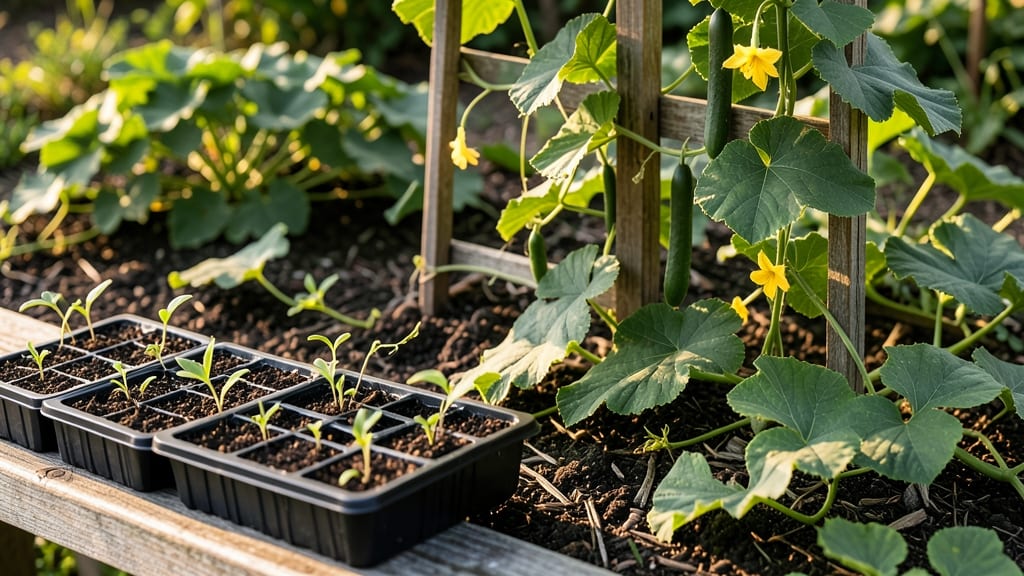
You can plant cucumbers and watermelon together, but they need strategic spacing and companion planting to prevent competition for sunlight and nutrients. Both plants thrive with at least 6 hours of direct sun daily and benefit from vertical support like trellises or raised beds.
These two vining plants share similar growing needs, but their sprawling habits make them competitive neighbors. 🌱 Watermelons need 3–4 feet of space to spread, while cucumbers prefer 2–3 feet—planting them too close leads to stunted growth and poor yields. The solution?
Use raised beds or trellises to lift them off the ground, giving roots room to breathe while maximizing your garden's vertical space. I've found that alternating rows of each plant with fast-growing companions like radishes or beans helps break up the competition while improving soil health.
Another key factor is their nutrient demands. Both cucumbers and watermelons are heavy feeders, so enrich your soil with compost before planting and consider a balanced fertilizer mid-season.
If you're working with limited space, container gardening is a great alternative—just ensure each plant has its own pot with drainage holes and plenty of room for roots to expand.
💡 In This Article
- Cucumber and Watermelon Growing Requirements: Soil, Sun, and Spacing Needs
- Best Companion Plants and Layout Strategies for Small Gardens
Cucumber and watermelon growing requirements: soil, sun, and spacing needs
Both cucumbers and watermelons demand full sun exposure (6+ hours daily) and rich, well-draining soil with a pH between 6.0 and 6.8. The key difference lies in their root systems—watermelons develop deep taproots that can reach 3–4 feet underground, while cucumbers have shallower, fibrous roots that spread horizontally.
This is why overcrowding leads to root competition: watermelon roots can outcompete cucumbers for water and nutrients, especially in dry conditions. 🌿
The spacing requirements reflect these growth habits: watermelons need 3–4 feet between plants and 5–6 feet between rows, while cucumbers thrive with 2–3 feet spacing.
In tight spaces, vertical growth solves the problem—trellising cucumbers saves up to 70% of ground space by lifting vines off the ground, while watermelons can be planted in raised beds with 12–18 inches of soil depth to accommodate their deep roots. The trade-off?
Watermelons may yield slightly smaller fruits when trellised, but the space savings often outweigh this.
Nutrient competition is another critical factor. Both plants are heavy feeders, particularly during fruiting. Cucumbers prioritize nitrogen for leafy growth, while watermelons need more potassium for fruit development. A soil test before planting reveals deficiencies—adding compost (high in nitrogen) and a balanced fertilizer (like 10-10-10) ensures neither plant starves.
Mulching with straw helps retain moisture and reduces soil-borne diseases, which both crops are susceptible to when stressed from competition. 💧
Temperature also plays a role in their compatibility. Watermelons germinate best in soil above 70°F, while cucumbers prefer 60–90°F. Planting them together in early spring means cucumbers may sprout faster, giving watermelons a head start once temperatures rise.
This staggered growth can prevent one plant from overwhelming the other. In cooler climates, use black plastic mulch to warm the soil and create microclimates for watermelons.
One surprising detail is how their growth habits change over time. Early in the season, cucumbers spread aggressively, while watermelons focus on root and vine development. By mid-summer, watermelons start vining rapidly, which is when vertical support becomes essential.
Without it, watermelon vines can smother cucumbers, reducing airflow and increasing disease risk. The solution? Install trellises or cages for cucumbers at planting and reserve ground space for watermelon vines to spread horizontally. 🌱
For those with limited space, consider the "three sisters" principle adapted for these crops: plant cucumbers vertically along a trellis, watermelons in a raised bed with 12-inch spacing**, and intersperse fast-growing radishes or beans between them.
This breaks up the competition while improving soil structure through nitrogen fixation from the beans. The result? A harmonious garden where both plants thrive without stunting each other's growth. ✨