
Companion Plants
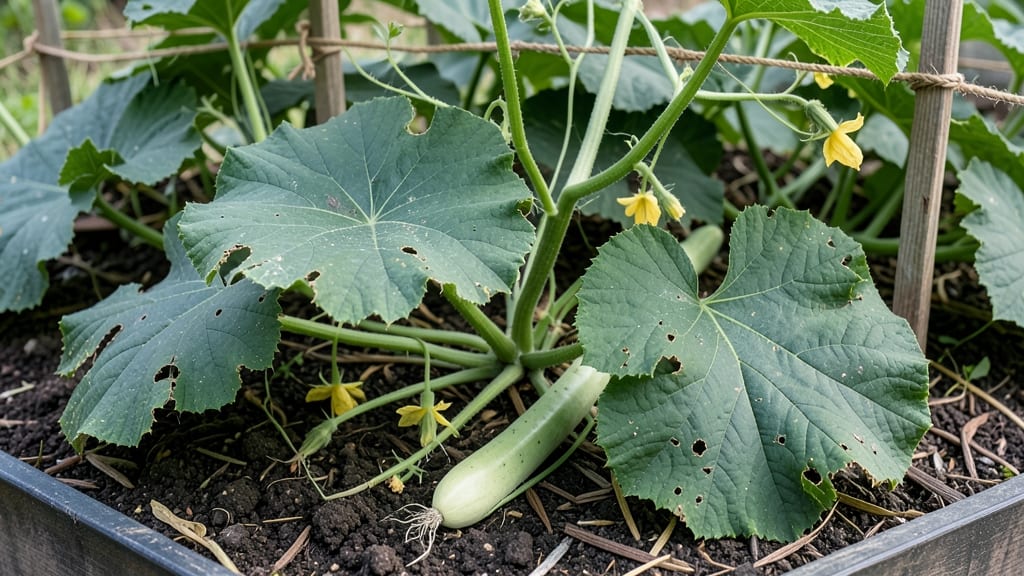
When you notice your cucumber plants being eaten, the culprits are usually pests like cucumber beetles, aphids, or slugs, or diseases such as powdery mildew or bacterial wilt. Check leaves, stems, and fruits for telltale signs like chewed edges, sticky residue, or unusual spots.
Cucumber plants face threats from both hungry pests and plant diseases, each leaving distinct clues. 🔥 Cucumber beetles create notched leaves and yellowing spots, while aphids leave behind sticky honeydew. Slugs, on the other hand, chew irregular holes and leave shiny trails.
Diseases like powdery mildew appear as white powdery coatings, while bacterial wilt causes sudden wilting and yellowing. The key is acting fast—whether you're removing pests by hand or applying organic treatments, early intervention prevents long-term damage.
For example, cucumber beetles not only eat foliage but also spread diseases, making them particularly dangerous. 🌱 I've found that companion planting with marigolds or basil can deter these pests naturally, while neem oil sprays provide immediate relief.
The sooner you identify the problem, the easier it is to protect your harvest.
💡 In This Article
- Common Cucumber Plant Pests and Their Damage Signs
- Organic Solutions for Cucumber Plant Pest Control
Common cucumber plant pests and their damage signs
Cucumber beetles are among the most destructive pests, identifiable by their bright yellow or green bodies with black stripes.
These beetles don't just eat leaves—they chew irregular notches along the edges, creating a jagged appearance. 🔥 What makes them particularly dangerous is their role as vectors for bacterial wilt, a disease that can devastate your entire crop within days.
Adult beetles lay eggs near the base of plants, and larvae burrow into roots, causing further damage. A single beetle can lay up to 1,000 eggs in its lifetime, which explains why infestations escalate rapidly.
Aphids, tiny green or black insects, cluster on the undersides of leaves, sucking sap and leaving behind a sticky residue called honeydew.
This residue attracts ants and promotes sooty mold growth, which blocks sunlight and stunts plant growth. 🌱 Unlike beetles, aphids don't chew leaves—they pierce plant cells with their needle-like mouthparts, causing leaves to curl and yellow. Heavy infestations can weaken plants to the point where they fail to produce fruits.
One way to confirm an aphid problem is to look for distorted new growth or a white, powdery substance (sooty mold) on leaves.
Slugs and snails leave behind a completely different set of clues.
These nocturnal creatures chew irregular holes in leaves, often along the outer edges, and leave behind shiny, silver trails of mucus. 💫 Unlike beetles or aphids, slugs are most active after rain or during humid evenings, which is why you might notice damage appearing overnight.
They also target young seedlings and fruits, creating holes that can ruin your harvest. A simple way to detect their presence is to place a board near your plants overnight—slugs will gather underneath it, making them easy to collect and remove.
Spider mites, though tiny, can cause significant damage by weaving fine webs on the undersides of leaves.
These pests thrive in hot, dry conditions and create stippled or yellowed patterns on leaves as they suck out chlorophyll. 🌿 Unlike aphids, spider mites are rarely visible to the naked eye, but their webs and the telltale speckled damage are dead giveaways.
Heavy infestations can cause leaves to dry out and fall off, reducing the plant's ability to photosynthesize and produce energy for fruit development.
Diseases like powdery mildew and bacterial wilt often mimic pest damage, which is why careful observation is key. Powdery mildew appears as a white, powdery coating on leaves, while bacterial wilt causes sudden wilting, yellowing, and a mushy stem when cut open. 🌱 The difference?
Mildew is a fungal infection that spreads slowly, whereas bacterial wilt moves through the plant's vascular system rapidly, often killing it within a week. Identifying the root cause—whether pest or disease—determines whether you need to apply organic sprays or adjust growing conditions.