
Planting
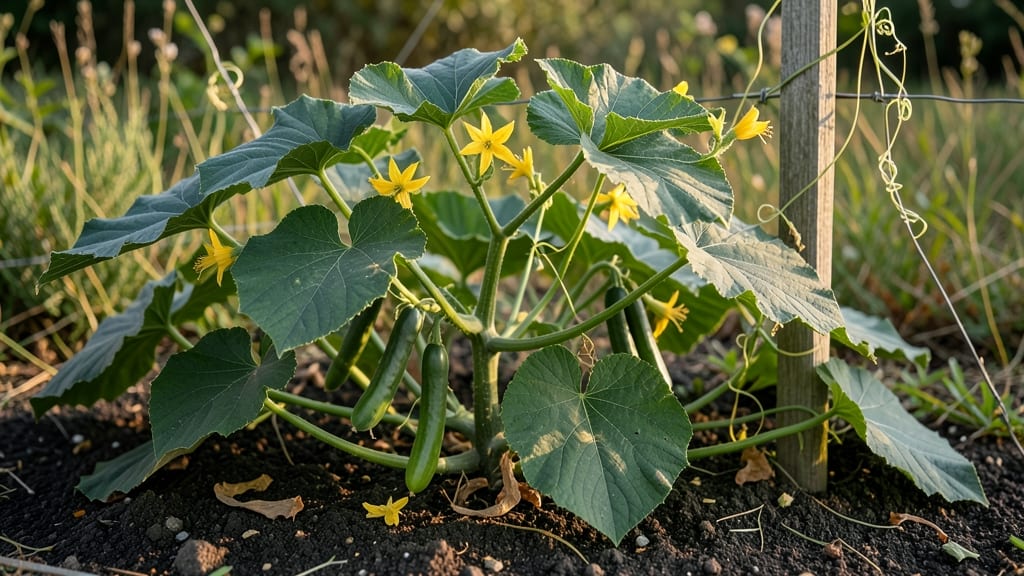
Cucumber plant leaves look like broad, heart-shaped blades with jagged, serrated edges, usually measuring 4-6 inches wide and displaying a vibrant dark green hue. These leaves grow alternately along the vines and feature prominent veins radiating from the central stem.
Cucumber plant leaves are instantly recognizable by their bold, lobed shape that resembles a hand with spread fingers. 🌿 The serrated edges create a distinctive sawtooth pattern, while the deep green color often appears slightly waxy to the touch.
Young leaves start smaller but quickly expand as the plant matures, with mature leaves sometimes reaching up to 8 inches in width. What sets them apart from similar vining plants like squash is their lighter green undersides and the way they grow in a more upright orientation along the stem.
The vein structure is another key identifier—thick central veins branch out into a network of smaller veins that create a web-like pattern. This vein arrangement helps distinguish cucumber leaves from melon leaves, which tend to have smoother edges and a more rounded shape.
When identifying cucumber plants, pay attention to these leaf characteristics as they remain consistent throughout the plant's growth cycle, from seedlings to mature vines.
💡 In This Article
- Distinct Characteristics of Cucumber Plant Leaves
- How to Identify Cucumber Leaves in Different Growth Stages
Distinct characteristics of cucumber plant leaves
Cucumber leaves exhibit a unique palmate shape resembling an open hand with five distinct lobes, though the number can vary between three and seven. The central stem, called the midrib, acts as the "palm" from which these lobes extend like fingers.
This shape distinguishes them from squash leaves, which typically feature more rounded lobes with smoother edges. The serrated edges aren't just decorative—they maximize surface area for photosynthesis while minimizing water loss through a specialized waxy coating called the cuticle, which gives mature leaves a slightly glossy appearance.
The dark green color (specifically a chlorophyll-rich RGB 25, 100, 25 shade) stems from high chlorophyll content, but younger leaves often appear lighter green due to lower chlorophyll concentration. This coloration helps cucumber plants absorb maximum sunlight for energy production.
The leaves grow alternately along the vine—each leaf emerges at a 90-degree angle from the previous one—creating a spiral pattern that optimizes sunlight exposure. This growth habit contrasts with melon vines, where leaves tend to grow more uniformly along the stem.
One of the most striking features is the vein structure, which forms a reticulate pattern (like a spiderweb) with prominent primary veins radiating from the midrib. These veins contain xylem and phloem tissues that transport water and nutrients throughout the plant.
The undersides of cucumber leaves are lighter green and often slightly fuzzy due to fine trichomes (hair-like structures) that deter pests. This fuzziness is more pronounced in younger leaves and serves as a natural defense mechanism against insects like aphids.
Size variations occur based on growth stage and plant health. Seedlings start with 1-2 inch leaves that expand rapidly to 4-6 inches in width during the flowering stage. Mature leaves can reach 8 inches or more under ideal conditions (full sun, proper watering).
The leaf texture is succulent—thick and slightly leathery—due to high water content stored in specialized cells called parenchyma. This thickness helps prevent wilting during hot days, a trait shared with other cucurbit family members like zucchini.
Comparing cucumber leaves to their closest relatives reveals key differences. Squash leaves, for example, have more rounded lobes with smoother edges, while melon leaves tend to be broader and less lobed, often with a bluer-green tint.
The cucumber's serrated edges and upright growth pattern along the vine are dead giveaways. Even the leaf stem (petiole) differs—cucumber petioles are hollow and hairy, while squash petioles are typically solid and smoother.
Identifying cucumber leaves accurately matters because misidentification can lead to treating the wrong plant with herbicides or fertilizers. The leaf arrangement (alternate vs. opposite) is a critical clue—cucumber leaves grow singly at each node, whereas plants like mint have opposite leaves.
This characteristic, combined with the hand-like shape and serrated edges, creates a visual signature that's hard to confuse with other common garden plants.