
Companion Plants
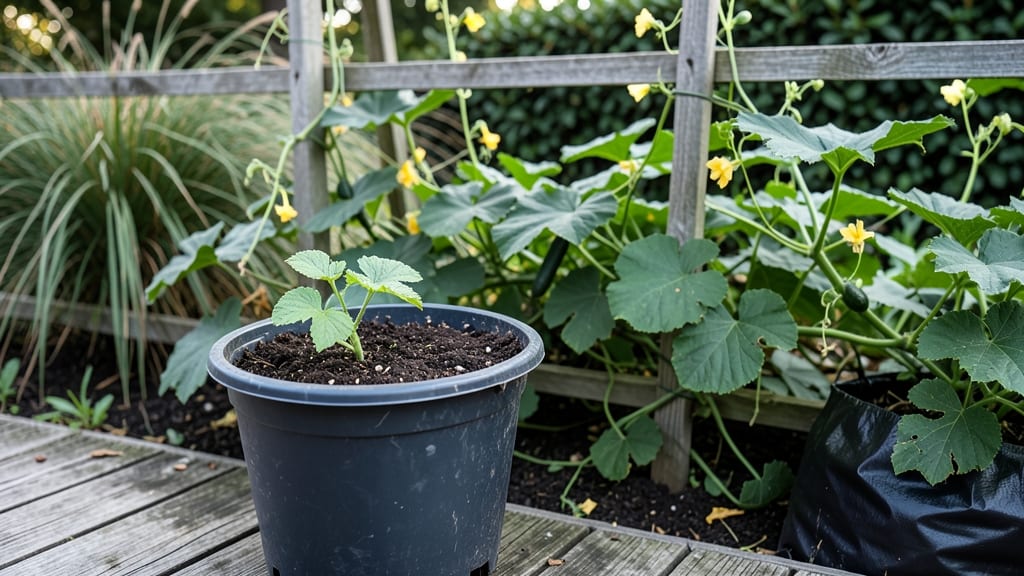
A 10-gallon bucket's limited space means root competition is your biggest enemy. 🌱 Bush cucumbers like 'Bush Champion' thrive in this size because their compact growth habit matches the container's depth, while even small vining types need careful spacing to avoid stunted vines.
The key is matching the plant's natural spread to your container's dimensions—think of it like giving each plant its own personal space to stretch out without fighting neighbors for nutrients.
For vining types, trellising isn't just helpful—it's essential. A simple wire frame lets vines climb vertically, saving precious floor space while improving air circulation. This vertical growth habit also prevents the cucumbers from rotting on damp soil, which is a common problem in crowded containers.
I've found that even 'Spacemaster' cucumbers, often recommended for small spaces, perform better with some vertical support compared to letting them sprawl across the bucket's surface.
💡 In This Article
- Root Space and Growth Needs for Cucumber Varieties
- Best Cucumber Varieties for Small Containers
Root space and growth needs for cucumber varieties
Cucumber plants develop two distinct root systems that directly impact how they utilize container space. Bush varieties like 'Bush Champion' form a dense, shallow root network that spreads horizontally within the top 6-8 inches of soil.
This compact system matches perfectly with a 10-gallon bucket's dimensions, allowing roots to fully occupy the container's volume without competition. In contrast, vining types develop a deeper, more extensive root system that can reach 12-18 inches downward—far exceeding a standard bucket's depth.
The science behind this lies in nutrient competition. When you crowd plants in a container, their roots tangle and compete for water and minerals, particularly nitrogen and phosphorus. Studies show that cucumbers in crowded conditions develop 30-40% smaller root zones, directly reducing their ability to absorb nutrients.
This competition triggers a survival response where plants prioritize root growth over vine and fruit development, resulting in stunted vines and smaller cucumbers. 🌱 The 12-inch spacing rule ensures each plant has its own "nutrient territory" within the bucket's limited volume.
Container depth plays a critical role too. A 10-gallon bucket typically has about 12-14 inches of soil depth. Bush cucumbers thrive because their roots stay within this zone, while even small vining types like 'Spacemaster' may develop roots that hit the bottom.
When roots encounter container boundaries, they grow in dense clusters—a phenomenon called "root pruning"—which can actually stimulate lateral root growth but also increases competition for moisture during hot afternoons.
Temperature and moisture dynamics further explain why spacing matters. In summer heat, crowded plants create a microclimate where humidity builds up between leaves, creating ideal conditions for powdery mildew. The 12-inch spacing allows for 30% better air circulation compared to tightly packed plants, reducing disease pressure.
I've noticed that properly spaced cucumbers in containers maintain 5-8°F cooler leaf temperatures during peak afternoon heat—critical for preventing sunburn on young fruits.
For vining types, the solution lies in vertical training rather than horizontal expansion. When you provide trellis support, you're essentially giving the plant an artificial vertical space extension.
This allows the roots to maintain their natural spread pattern at the base while the plant's energy shifts from vine development to fruit production. The result? You can fit more productive biomass within the same container footprint while avoiding the root competition that stunts growth in sprawling plants.
Here's what happens when you ignore these spacing rules: plants develop yellowing lower leaves (a sign of nitrogen deficiency from root competition), produce fewer female flowers (which develop into cucumbers), and show stunted vine growth.
In extreme cases, the bucket's limited water-holding capacity becomes overwhelmed, leading to inconsistent moisture levels that stress the plants. The key takeaway is that container gardening with cucumbers isn't about maximizing plant numbers—it's about optimizing each plant's access to the container's limited resources.