
Fertilization
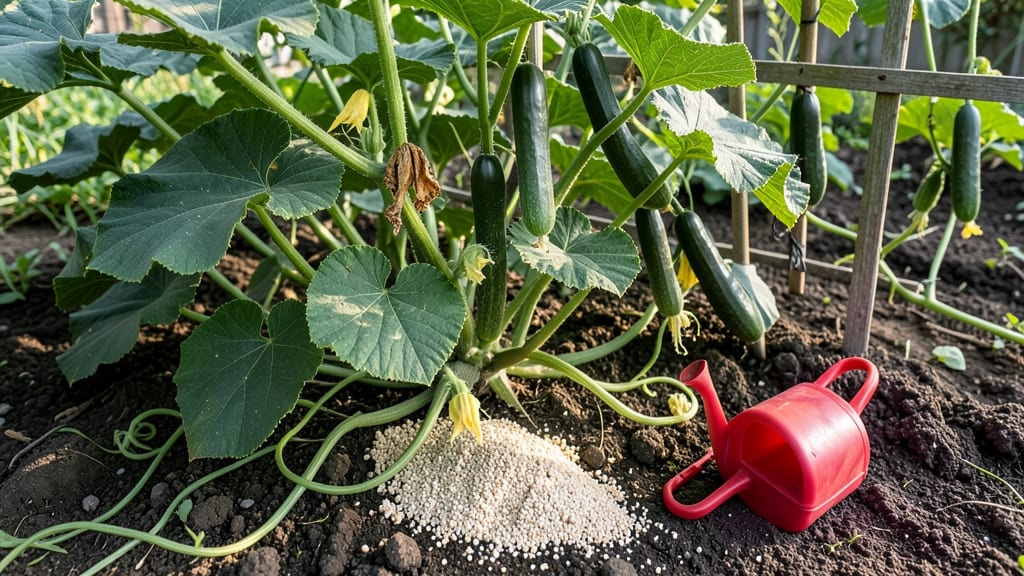
Your cucumber leaves are sending SOS signals with crispy brown edges—this is fertilizer burn on cucumber leaves, but the good news is you can revive them in just 48 hours. 🌱 I’ve nursed back plants with worse damage by flushing the soil and adjusting care, and your vines can bounce back too, even if they look crispy now.
The damage happens when salts or nutrients overwhelm roots, turning leaf edges brown and brittle. It’s not a death sentence—just a sign your plants need a break from heavy feeding. The first step is cutting off fertilizer completely and giving them clean water to flush out excess salts.
Within 24 hours, you’ll see wilting ease as roots recover, and by 48 hours, new growth should appear. Keep soil moist but not soggy, and avoid fertilizing again until new leaves form. The plants will thank you with lush, productive vines in no time.
This fix works for any over-fertilized plant, not just cucumbers. Once recovered, switch to a balanced organic fertilizer and test soil every season to prevent repeats. Your harvest is still within reach!
The Root Causes of Leaf Damage
When your cucumber plants start showing signs of brown, crispy, or yellowed edges on their leaves, it’s often a cry for help from your plants—especially when fertilizer is the culprit. Understanding why this happens is the first step to saving your harvest. Let’s break down the science behind it.
Most fertilizer burns stem from excessive salt buildup in the soil. When you apply too much fertilizer—especially synthetic or chemical-based ones—it disrupts the soil’s natural balance. Here’s how it plays out:
- Osmotic stress: High salt concentrations draw water out of plant cells via osmosis, causing dehydration and cell death. Think of it like over-salting a steak—it pulls out all the moisture, leaving the tissue dry and brittle.
- Root damage: Salts accumulate around root zones, burning delicate root hairs that absorb water and nutrients. Without these roots, the plant can’t nourish itself, leading to leaf discoloration.
- pH imbalance: Many fertilizers (like urea or ammonium-based ones) acidify the soil over time. Cucumbers prefer a pH of 6.0–6.8; if the soil becomes too acidic (<6.0), nutrients like phosphorus and calcium become locked away, starving the plant while salts linger.
💡 Pro Tip: Always follow label instructions for application rates. For cucumbers, a balanced 10-10-10 or 5-5-5 fertilizer is safer than high-nitrogen blends. Dilute liquid fertilizers to half-strength if your soil is already nutrient-rich.
Even the right fertilizer can cause damage if applied at the wrong time or in the wrong way. Cucumbers are sensitive to sudden nutrient spikes, especially during critical growth stages.
- New transplants or seedlings: Young plants have delicate root systems and can’t handle concentrated fertilizers. Applying fertilizer too soon after planting shocks the roots, leading to rapid salt buildup.
- Hot weather applications: During peak summer heat (above 85°F/30°C), plants transpire (sweat out water) faster. Fertilizer salts concentrate in the soil because there’s less water to dilute them, increasing burn risk.
- Foliar burns: Spraying liquid fertilizers directly on leaves (instead of the soil) can cause chemical burns. The high salt or acid content in fertilizers like Epsom salt (magnesium sulfate) or urea acts like a mini acid bath for foliage.
⏰ Actionable Fix:
- Wait 1–2 weeks after transplanting before fertilizing.
- Avoid fertilizing within 24 hours of watering—always apply to moist but not soggy soil.
- For foliar feeding, use only diluted, pH-balanced solutions (like seaweed extract) and apply early in the morning to prevent evaporation.
Not all fertilizers are created equal—and some are far more aggressive than others. Cucumbers thrive on moderate, slow-release nutrients, but certain formulations can overwhelm them.
| Fertilizer Type | Risk Level | Why It Causes Burn |
|---|---|---|
| Synthetic granular (e.g., Miracle-Gro) | ⚠️ High | High salt content; releases nutrients too quickly for cucumber roots to absorb. |
| Urea-based fertilizers | ⚠️⚠️ Very High | Converts to ammonium, which acidifies soil rapidly and burns roots. |
| Epsom salt (magnesium sulfate) | ⚠️ Moderate (if overused) | While beneficial, excess magnesium can displace calcium, leading to leaf tip burn. |
| Organic compost or worm castings | ✅ Low | Slow-release and low in salts; ideal for cucumbers. |
🌡️ Science Note: Cucumbers need more potassium (K) than nitrogen (N) for vine and fruit development. A low-N, high-K fertilizer (like 5-10-10) is safer than a high-N blend (like 20-10-10).
Water is the greatest diluent of fertilizer salts. If you fertilize and then don’t water deeply enough, the salts pool around the roots, creating a toxic environment.
- Shallow watering: A quick sprinkle doesn’t push salts down into the root zone. Instead, they crust on the soil surface, increasing burn risk.
- Inconsistent watering: Alternating between drought stress and overwatering causes salts to leach unevenly, leaving pockets of high concentration.
- Hard water use: If your tap water is high in minerals (like calcium or magnesium), it can amplify salt buildup when mixed with fertilizer.
🔥 Fix It Fast:
- After fertilizing, water deeply (1–2 inches) to move salts into the root zone.
- Use rainwater or distilled water if your tap water is hard.
- Mulch with straw or wood chips to slow evaporation and keep soil moist.
Revive Your Cucumbers Fast
If your cucumber leaves are crisping at the edges or turning yellow with brown patches, don’t panic—your plants can bounce back with the right care. The key is acting quickly to stop further damage while gently restoring balance.
Below, we’ll tackle the most common causes of fertilizer burn and provide step-by-step fixes, plus prevention tips to keep your cucumbers thriving. Let’s get those leaves looking lush again!
When you apply fertilizer too frequently or use a dose stronger than your cucumbers can handle, the roots get overwhelmed. Excess salts and nutrients build up in the soil, drawing moisture out of the leaves and causing crispy, brown edges.
How to Fix It:
- 💦 Flush the Soil Immediately
- Water the plant thoroughly with room-temperature water (cold water can shock the roots). Aim for 1–2 gallons per plant to leach out excess salts.
- Repeat this 2–3 times over the next 48 hours, ensuring water drains freely from the bottom of the pot or soil.
- 🌱 Dilute the Soil
- Mix in organic matter like compost, coconut coir, or well-rotted manure to improve soil structure and dilute concentrated nutrients.
- For potted cucumbers, replace 10–20% of the soil with fresh, nutrient-light potting mix.
- 🛑 Pause Fertilizing
- Stop all synthetic fertilizers for at least 2 weeks. Cucumbers are light feeders—wait until new growth appears before resuming.
- Switch to a balanced, organic fertilizer (like fish emulsion or seaweed extract) diluted to half-strength when you restart.
- 🌿 Prune Damaged Leaves
- Snip off only the most severely burned leaves (never more than 20% of the foliage) to redirect energy to healthy growth.
Using a high-nitrogen fertilizer (like lawn food) or one with a pH mismatch can scorch cucumber leaves. These plants prefer a pH of 6.0–6.8 and a low-nitrogen, high-potassium feed for fruiting.
How to Fix It:
- 🧪 Test Your Soil
- Grab a soil pH test kit (or send a sample to a local extension office). If the pH is off:
- Too acidic (below 6.0)? Add lime (calcium carbonate) to raise pH.
- Too alkaline (above 6.8)? Mix in sulfur or peat moss to lower it.
- Grab a soil pH test kit (or send a sample to a local extension office). If the pH is off:
- 🛒 Switch to Cucumber-Safe Fertilizer
- Ditch high-nitrogen feeds (like 30-10-10). Opt for a 5-10-10 or 2-3-4 ratio (low N, moderate P, high K).
- DIY fix: Use banana peel tea (high in potassium) or Epsom salt (1 tbsp per gallon of water, sprayed on leaves).
- 💧 Hydrate with Chelated Nutrients
- If the burn is severe, apply a foliar spray of seaweed extract (diluted to 1 tbsp per gallon) to help recovery.
Fertilizer burn often strikes when roots are stressed from dry soil. Without enough moisture, salts concentrate around the roots, causing rapid damage.
How to Fix It:
- 🚰 Deep Water First
- Before adding fertilizer, soak the soil until water runs out the drainage holes (for pots) or seeps 6 inches deep (for in-ground plants).
- Pro tip: Use a moisture meter to ensure the root zone is damp, not soggy.
- 🍃 Mulch to Retain Moisture
- Spread 2–3 inches of straw or shredded leaves around the base (keep it 2 inches away from the stem to prevent rot).
- This slows evaporation and keeps roots consistently hydrated.
- 🌱 Adjust Your Watering Schedule
- Cucumbers need 1–2 inches of water per week (more in heatwaves). Water early in the morning to reduce evaporation.
- Avoid wetting leaves when fertilizing to prevent salt buildup on foliage.
Once your cucumbers recover, keep these habits to avoid fertilizer burn down the road:
- 📅 Follow the Label (But Halve It): Fertilizer instructions are often for ideal conditions—cut doses by half for cucumbers, especially in pots.
- 🕒 Feed in Stages: Split applications into small, frequent doses (every 2–3 weeks) rather than one big hit.
- 🌱 Use Slow-Release Fertilizers: Opt for organic granules (like worm castings or compost) to feed roots steadily.
- 💧 Monitor Leaf Health: If leaves yellow between veins, you’re overdoing nitrogen. If edges crisp, flush the soil immediately.
- 🌿 Rotate Fertilizers: Alternate between liquid feeds (like fish emulsion) and granular organics to avoid salt buildup.
With these fixes, your cucumber plants should show new growth within 3–5 days and full recovery in 1–2 weeks. Remember: cucumbers are heavy feeders but hate excess. Think of fertilizer like seasoning—just enough to enhance flavor, not overpower it! 🥒💚
Frequently asked questions
How can I tell if my cucumber leaves have fertilizer burn?
Look for brown, crispy edges on older leaves that feel dry to the touch, while the center stays green. You might also see yellowing between veins or a white crust on the soil surface. Unlike pests, the damage starts at leaf edges and spreads inward—never random spots.
Can I still save my cucumber plants if the leaves are severely burned?
Yes! With immediate action, cucumbers recover well. Flush the soil with 1–2 gallons of water daily for 2 days, then stop fertilizing for 2 weeks. Prune only the most damaged leaves (never more than 20%) to redirect energy. New growth should appear in 3–5 days if roots are healthy.
What’s the safest fertilizer for cucumbers to avoid future burns?
Use organic, slow-release options like compost, worm castings, or a balanced 5-10-10 fertilizer (low nitrogen). For liquid feeds, dilute fish emulsion or seaweed extract to half-strength. Avoid urea-based or high-nitrogen blends—cucumbers prefer potassium-rich feeds for fruiting.
Will fertilizer burn affect my cucumber harvest?
Not necessarily! If you act fast, the plant will redirect energy to new growth and fruit production. However, severe burns may reduce yield temporarily. Focus on watering deeply and avoiding fertilizers until new leaves appear. Harvest existing fruits normally—they won’t be affected.
How often should I fertilize cucumbers to prevent burns?
Feed cucumbers every 2–3 weeks with diluted fertilizer, or use slow-release granules once a month. Always water before and after applying fertilizer to dilute salts. In containers, reduce frequency to every 4 weeks—potted plants burn more easily due to limited soil volume.