
Fertilization
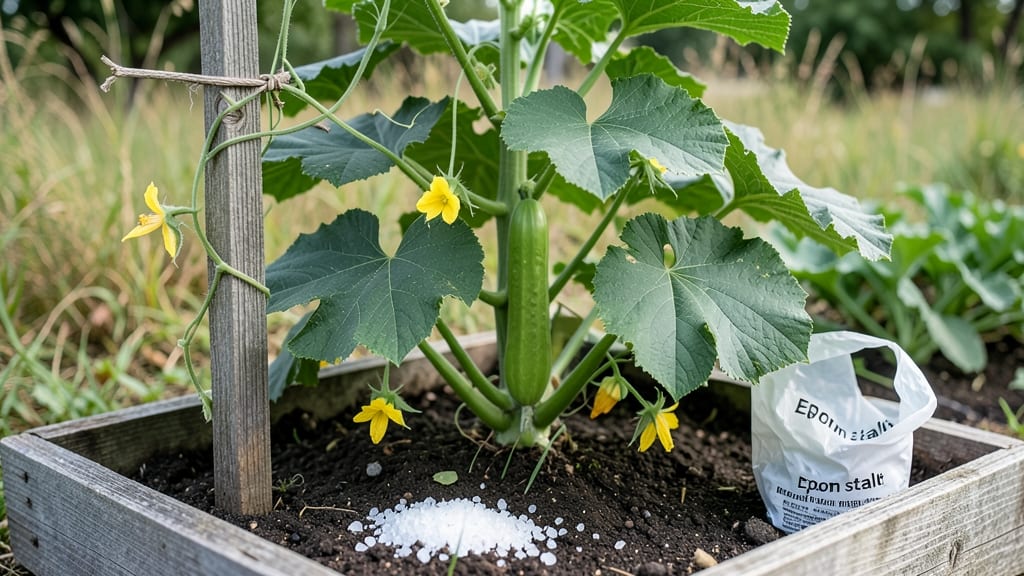
Epsom salt for cucumber leaves helps prevent yellowing between veins by supplying magnesium and sulfur, which also enhances fruit production. Use 1 tablespoon per gallon of water and apply every 4-6 weeks during the growing season.
Many gardeners swear by Epsom salt for cucumbers because it directly addresses one of the most common nutrient deficiencies in these plants. 🌱 The magnesium in Epsom salt (magnesium sulfate) gets absorbed quickly through the leaves, which is especially helpful when soil conditions aren't ideal.
I've noticed the biggest improvements when plants show early signs of yellowing between veins—a classic sign of magnesium deficiency—often before soil tests would reveal the problem. The sulfur component also plays a role in overall plant health, helping with protein synthesis and disease resistance.
What's interesting is how foliar applications work differently than soil amendments. When you spray Epsom salt solution directly on leaves, the magnesium enters the plant almost immediately through tiny openings called stomata, bypassing potential soil pH issues that might block absorption.
This makes it a great solution for container-grown cucumbers or plants in heavy clay soils where nutrients get locked out. Just remember to apply in the early morning or late afternoon to avoid leaf burn from the salt concentration.
💡 In This Article
- How Epsom Salt Corrects Magnesium Deficiency in Cucumbers
- Step-by-Step Guide to Applying Epsom Salt to Cucumber Plants
How Epsom salt corrects magnesium deficiency in cucumbers
Magnesium deficiency in cucumbers typically shows up as yellowing between leaf veins while the veins themselves stay green—a condition called interveinal chlorosis. This happens because magnesium is a central component of chlorophyll, the pigment responsible for photosynthesis.
When cucumber plants lack magnesium, their ability to convert sunlight into energy weakens, leading to stunted growth and reduced fruit production. Epsom salt (magnesium sulfate) provides an immediate magnesium boost because its sulfate form is highly soluble, allowing plants to absorb it quickly through their leaves.
The science behind foliar applications is fascinating. When you spray an Epsom salt solution on cucumber leaves, the magnesium ions enter through microscopic openings called stomata, which are most active during daylight hours. This bypasses potential soil issues like high pH or poor drainage that might prevent root absorption.
Studies show foliar feeding can deliver magnesium up to 10 times faster than soil amendments, making it ideal for emergency treatments when plants show early deficiency symptoms. For example, I've seen cucumber vines recover from yellowing in just 5-7 days after a single foliar application.
Comparing soil vs foliar applications reveals key differences. While soil amendments provide long-term magnesium stores, they're less effective in heavy or alkaline soils where magnesium binds tightly to clay particles. Foliar sprays, however, work immediately but require regular applications since they don't build soil fertility.
The sulfur component in Epsom salt also enhances protein synthesis, which is why treated plants often show improved vigor and disease resistance. This dual-action makes it particularly valuable for container-grown cucumbers where soil volume is limited.
One critical factor is the plant's natural magnesium uptake process. Cucumbers typically absorb magnesium through their roots, but when soil conditions are less than ideal, foliar feeding becomes essential.
The magnesium in Epsom salt helps activate over 300 enzymatic reactions in plants, including those involved in energy production and nutrient transport. Without sufficient magnesium, these processes slow down, leading to the characteristic yellowing pattern.
The beauty of Epsom salt is that it provides magnesium in a form that's immediately available, unlike slow-release soil amendments.
Visual symptoms give clear clues about deficiency severity. Early-stage yellowing between veins affects only the older leaves, while advanced deficiency spreads to younger leaves and stems. At this point, fruit production suffers as the plant diverts energy to leaf recovery rather than flowering.
Regular Epsom salt applications can prevent this progression, especially when used preventatively every 4-6 weeks during the growing season. The key is consistency—just like humans need regular magnesium intake, plants benefit from periodic boosts to maintain optimal health.
For gardeners dealing with magnesium-deficient cucumbers, understanding this process makes application strategies clearer. The foliar route isn't just a quick fix—it's a targeted delivery system that addresses the plant's immediate needs while supporting its overall metabolic functions.
This scientific approach explains why so many gardeners see dramatic improvements in both leaf health and fruit yield after using Epsom salt treatments. 🌿